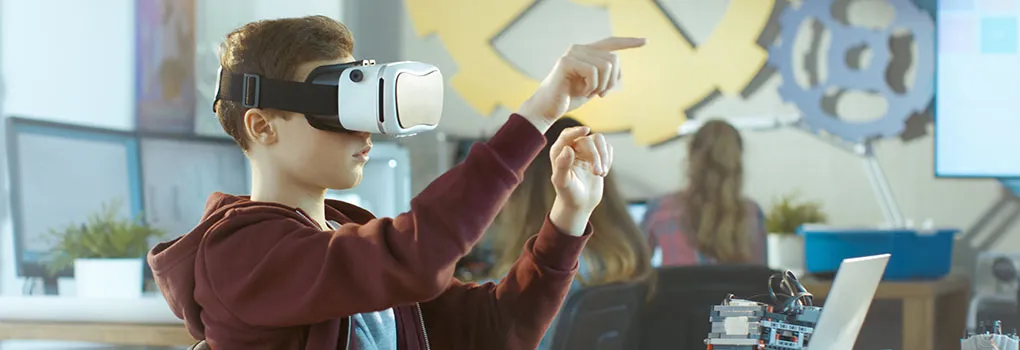

Education VR/AR experiences are transforming classrooms by making learning immersive, interactive, and highly engaging. In an era where students are accustomed to technology-driven environments, integrating virtual and augmented reality into education offers a unique way to capture attention and enhance understanding. These experiences allow learners to explore, experiment, and interact with complex concepts in ways that traditional teaching methods cannot replicate.
The rise of education VR/AR experiences reflects the growing demand for experiential learning. Students no longer need to rely solely on textbooks or lectures; they can virtually visit historical landmarks, dissect biological specimens, or explore chemical reactions in a safe digital environment. This technology bridges the gap between theory and practice, fostering deeper comprehension and retention.
How Education VR/AR Experiences Enhance Learning
The primary advantage of education VR/AR experiences lies in engagement and interactivity. Unlike conventional classrooms, VR and AR enable students to actively participate in learning scenarios. For instance, in a biology class, students can virtually explore the human circulatory system, observing blood flow and heart function from within the body. This level of immersion transforms abstract concepts into tangible understanding.
In STEM education, VR laboratories allow learners to conduct experiments safely, while AR overlays provide interactive explanations on real-world objects. These hands-on experiences not only improve retention but also develop problem-solving and critical thinking skills. Students engage with content dynamically, enhancing both curiosity and confidence.
Real-Life Applications of Education VR/AR Experiences
Across the globe, schools and universities are integrating education VR/AR experiences to boost learning outcomes. In the United States, students use VR to simulate physics experiments that would be too dangerous or costly in traditional labs. In Europe, AR tools bring historical events to life by overlaying 3D reconstructions of ancient civilizations in classroom settings.
In India, a school in Bangalore implemented VR modules for environmental science, allowing students to virtually explore ecosystems and understand climate change effects firsthand. Teachers report increased engagement and better conceptual understanding, proving the transformative potential of VR and AR in education.
Technology Behind Education VR/AR Experiences
The effectiveness of education VR/AR experiences is powered by advanced technologies such as virtual reality headsets, augmented reality apps, 3D modeling, and interactive simulations. These platforms leverage AI and analytics to personalize content, track progress, and identify areas where students may need additional support.
VR provides fully immersive digital worlds, while AR enhances the real environment with interactive overlays. For example, AR applications in anatomy classes can project detailed 3D models of organs onto textbooks, allowing students to examine them from different angles. Combined with AI-driven feedback, these tools create a holistic learning environment tailored to individual needs.
Benefits for Students
Students benefit greatly from education VR/AR experiences in multiple ways. Immersive learning improves understanding, memory retention, and engagement. Students can experiment without fear of mistakes, gaining practical experience that is directly applicable to real-world scenarios.
Additionally, VR and AR encourage collaborative learning. Students can work together in virtual spaces, solving problems and completing projects collectively. This enhances communication, teamwork, and social interaction, preparing learners for both academic and professional environments.
Supporting Educators Through VR/AR Integration
Teachers also gain significant advantages from education VR/AR experiences. Digital tools provide insights into student engagement, learning patterns, and performance. Educators can adapt lesson plans based on real-time data, ensuring that every student receives the support needed to succeed.
Professional development programs also integrate VR/AR simulations, enabling teachers to practice classroom management, instructional strategies, and new teaching techniques. By combining immersive training for educators with interactive learning for students, VR and AR create a comprehensive educational ecosystem.
Future Trends in Education VR/AR Experiences
The future of education VR/AR experiences is poised for exponential growth. Emerging technologies like mixed reality, AI-driven adaptive learning, and cloud-based VR classrooms will expand the possibilities of immersive education. Students will access personalized experiences that adapt to their learning pace and style, creating more efficient and enjoyable education pathways.
Universities and vocational training centers are expected to adopt VR/AR for skill-based programs, simulating real-world scenarios in fields like medicine, engineering, and logistics. This hands-on exposure prepares learners for professional environments without the limitations of physical infrastructure or safety concerns.
Overcoming Challenges
Despite their advantages, education VR/AR experiences face challenges such as cost, accessibility, and technical literacy. High-quality VR headsets and AR applications can be expensive, and not all institutions have the infrastructure to implement them fully. However, ongoing technological advancements, cloud-based solutions, and affordable AR apps are making immersive learning increasingly accessible.
Teachers and students must also be trained to effectively use these tools. Professional development and structured onboarding programs help maximize the benefits of VR and AR, ensuring that technology complements pedagogy rather than complicating it.
Hybrid Learning and VR/AR Integration
A notable trend within education VR/AR experiences is their integration into hybrid learning models. Combining VR/AR with online and in-person instruction creates flexible, engaging, and adaptive classrooms. Students can experience immersive lessons at home while participating in discussions and collaborative activities in physical classrooms.
This hybrid approach bridges gaps in understanding, fosters continuous engagement, and allows educators to monitor progress in real-time. By merging immersive technology with traditional learning methods, hybrid classrooms provide the best of both worlds.
Skill Development Through VR/AR
Education VR/AR experiences also play a pivotal role in skill development. Learners in fields such as medicine, aviation, engineering, and IT can simulate practical tasks, troubleshoot problems, and refine techniques in a safe, controlled environment. This accelerates learning and builds confidence before transitioning to real-world applications.
For instance, medical students can perform virtual surgeries, engineers can test structures under simulated conditions, and pilots can practice emergency scenarios. These experiences are not only educational but also career-transforming, giving learners a competitive edge in their chosen fields.
Read also:
e-shiksha kosh
e shikshakosh download
e shikshakosh बिहार
e shikshakosh.bihar.gov.in